About the lab
What is the Area & Perimeter Lab?
Area is how much space a shape covers; perimeter is the distance round its edge. On the Build bench, children tap squares on squared paper to make any shape they like. The area is the number of squares, the perimeter is drawn as a bright edge, and Count it numbers every square and every edge so the two are never confused. They soon notice that the same six squares can have a perimeter of 10, 12 or 14, depending on how much they touch.
The Gardens bench builds rectangles from sliders, drawn as gardens with a fence round them. Every garden measured goes into a table, so children can find all the rectangles with an area of 12, or see that 20 metres of fence makes the biggest garden as a 5 by 5 square.
Three levels, from counting squares to πr²
Beginners count squares and edges, make rectangles and squares and see that spreading squares out makes a longer edge. Explorers use length × width and 2 × (length + width), find factor pairs and the biggest area for a fence, and cut parallelograms and triangles to understand their formulas. Advanced learners prove the trapezium rule with two copies of the shape, reason about the smallest and largest perimeter for a given area, and cut a circle into 4 to 32 slices that line up into a rectangle πr long and r tall.
Why seeing it matters
Children often learn area formulas as rules to remember and then mix them up. In the lab every formula comes from something they can watch: rows of squares for length × width, a sliding triangle for the parallelogram, a turned copy for the triangle and the trapezium, and an unrolled circle for πr². Each result comes with a short explanation written for the child's level, and the numbers update the moment a shape changes.
How it fits with other PlayPuzzle maths
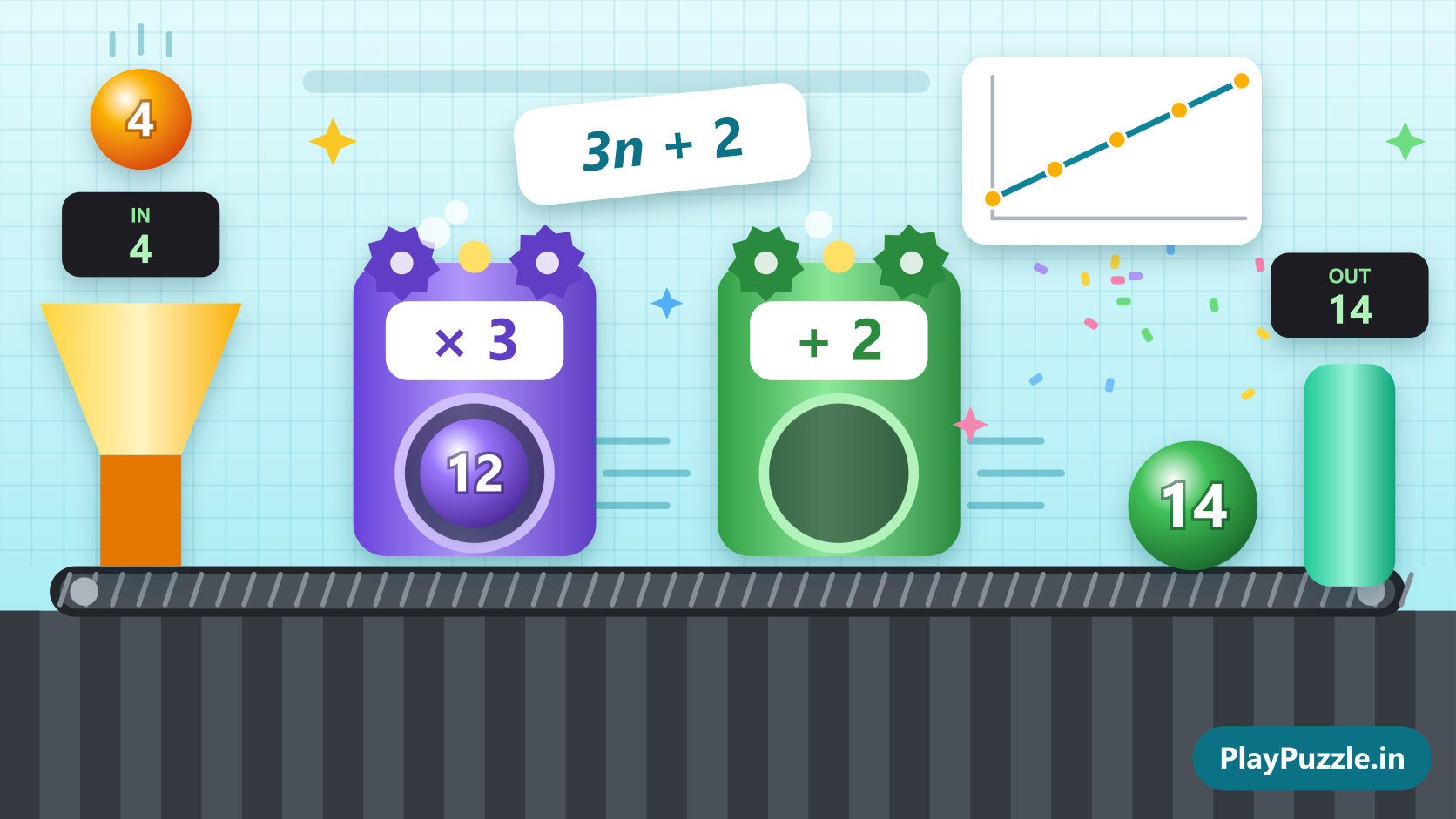
Number Puzzle and Bubble Pop Math build the multiplication facts that area depends on, and Place Value Quest the number sense behind measuring. Algebra Machine, the next lab in the Maths wing, turns the same kind of thinking into rules with letters, such as 2(l + w) for a perimeter.
Missions you can try
Beginner, ages 6–8 Free, no sign-in
- Six squares
- Ten round the edge
- Six inside, ten round
- Long and thin
- A garden of 12
- A square garden
Explorer, ages 9–11 Free with sign-in
- Same area, new edge
- Eight, spread out
- Every garden of 12
- The biggest garden
- Same fence, different gardens
- Slide it straight
- Half a parallelogram
Advanced, ages 12–14 PlayPuzzle Premium
- The shortest fence
- Area and fence together
- The trapezium rule
- Courtyard floor plan
- Playground planner
- A circle of about 50
- Unroll a circle
- Find pi
How to play
- Choose a bench: Build, Real world or, from Explorer, Shapes and, at Advanced, Circles and 3D Faces.
- On Build, draw freely or open a square, rectangle, irregular shape, compound shape or floor-plan starter, then press Count it.
- On Real world, switch between gardens, playgrounds, tiles and picture frames, move the dimension sliders and press Measure.
- On Shapes, set the base and height, then press Cut and rearrange to see why the formula works.
- On Circles, choose a radius and a number of slices, then press Unroll.
- On 3D Faces, tap a face to measure its 2D area, then open the net to add all six faces for surface area.
- Play missions for stars, or explore freely and collect discoveries.
What kids learn
- Area is the space a shape covers, measured in squares; perimeter is the distance round its edge.
- Shapes with the same area can have different perimeters.
- Area of a rectangle = length × width; perimeter = 2 × (length + width).
- For a fixed perimeter, the squarest rectangle has the largest area.
- Why parallelograms, triangles and trapeziums have the area formulas they do.
- Circumference = 2πr and area = πr², and what π means.
- A 3D object has 2D faces: one face has an area, while all outside face areas together make its surface area.
Skills practised
Levels and ages
- Beginner, ages 6–8: Free, no sign-in, 6 missions.
- Explorer, ages 9–11: Free with sign-in, 13 missions.
- Advanced, ages 12–14: PlayPuzzle Premium, 21 missions.
Levels are opened by plan and never locked by age, so any child can pick the level that suits them.
Is it safe?
Everything in the lab happens on screen. Children work only with the numbers and shapes on their bench, with no chat, no adverts and no timers, and nothing to try for real.
Frequently asked questions
What is the difference between area and perimeter?
Area is how much space a flat shape covers, counted in squares. Perimeter is the distance all the way round its edge, counted in lengths. A garden's area is its grass; its perimeter is its fence.
Can two shapes have the same area but different perimeters?
Yes. Six squares in a 2 by 3 rectangle have a perimeter of 10, but in a straight line they have a perimeter of 14. Squares that touch hide the edges between them.
Why is the area of a triangle half of base times height?
Two copies of any triangle fit together into a parallelogram with the same base and height, whose area is base × height. So one triangle is half of that.
Why is the area of a circle πr²?
Cut a circle into thin slices and line them up, pointing up and down in turn. They make nearly a rectangle that is half the circumference (πr) long and one radius (r) tall, so the area is πr × r = πr².
What ages is the Area & Perimeter Lab for?
Ages 7 to 14. Beginners count squares and edges, Explorers use the rectangle, parallelogram and triangle formulas, and Advanced learners prove the trapezium rule and work with circles and π.
Is the Area & Perimeter Lab free?
Yes. The Beginner level is free with no sign-in. A free account opens the Explorer level, and PlayPuzzle Premium opens Advanced.