
Game overview
About Food Chain Adventure
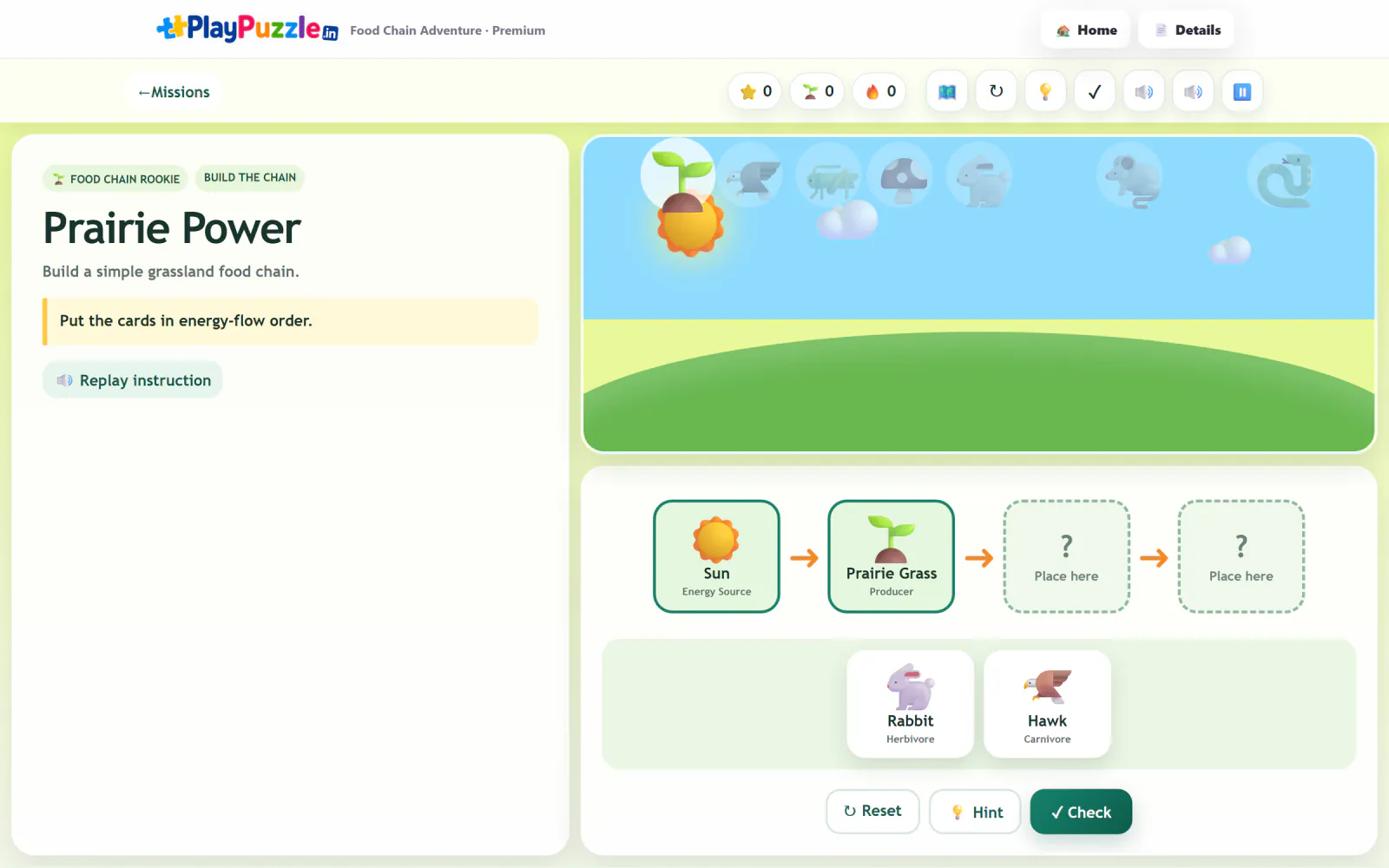
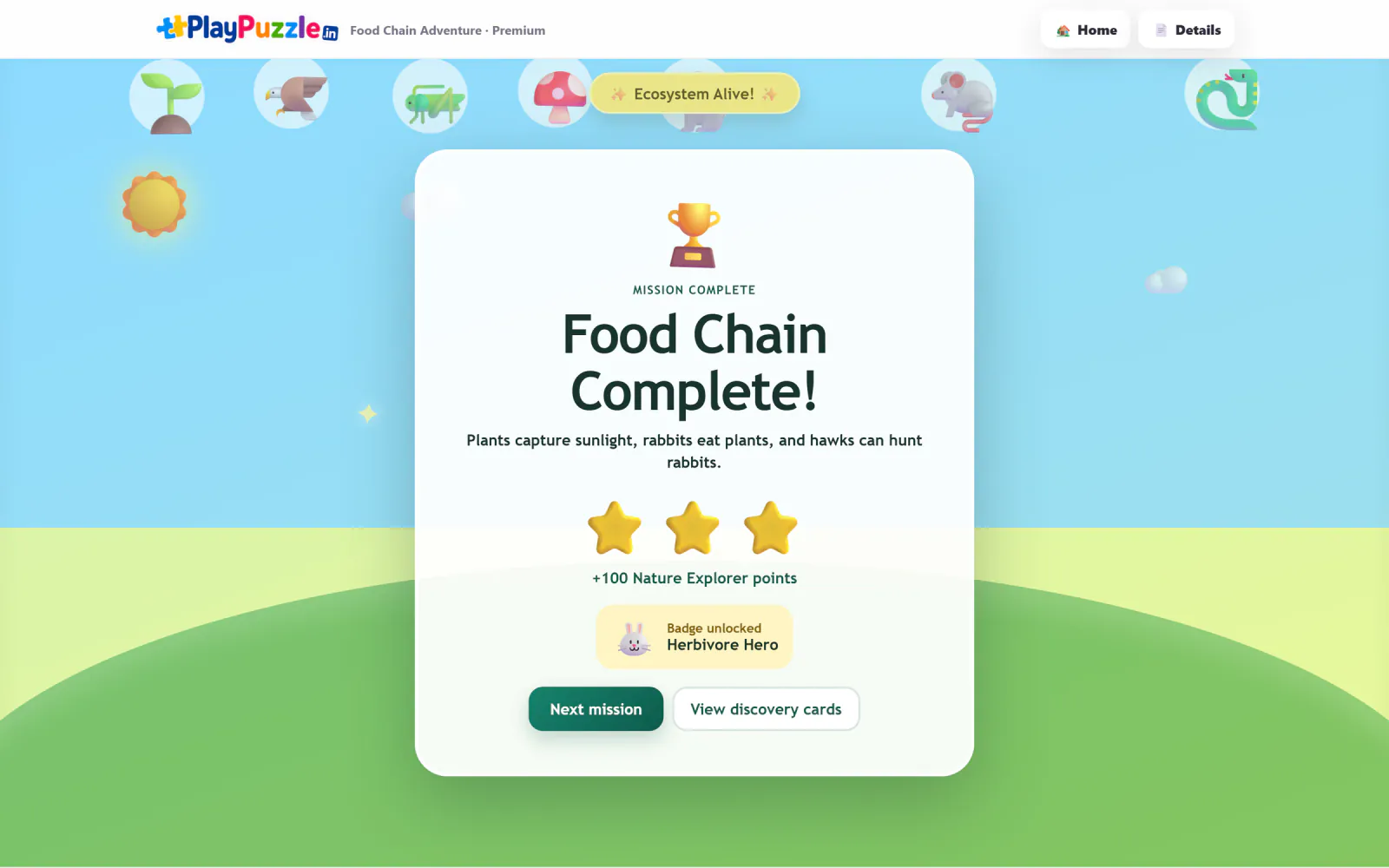
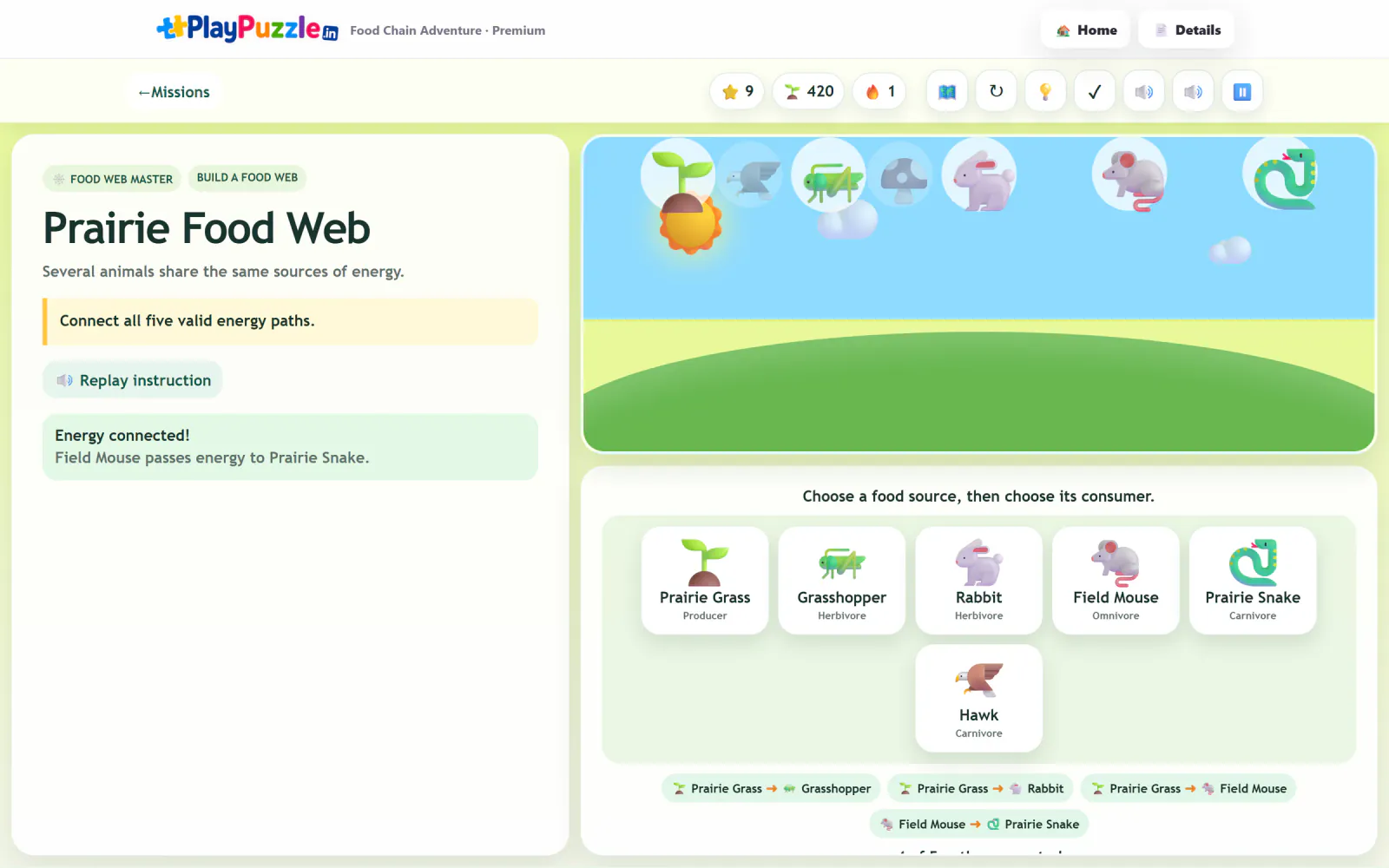
Food Chain Adventure is a Premium science and biology game for PlayPuzzle members aged 6 to 12. Children explore Grassland, Forest, Pond, Ocean, Desert, and Arctic habitats; discover organism cards; then drag, tap, or use the keyboard to connect producers, herbivores, omnivores, carnivores, and decomposers. Ten mission types grow from simple food chains to multi-path food webs and survival simulations. Every arrow consistently shows energy moving from the food to the organism that consumes it, teaching hints explain mistakes without revealing the whole answer, and each correct connection wakes up another part of the habitat. Stars, Nature Explorer points, streaks, badges, and a collectible encyclopedia reward progress, which is stored locally and synced for signed-in players.
Skills kids can practice
Features
- Six data-driven habitats
- Ten varied mission types
- Ecosystem Comes Alive animations
- Narrated organism names, facts, hints, and feedback
- Drag, tap, touch, and keyboard play
- Stars, badges, streaks, and discovery cards
How to Play
- Choose an unlocked habitat and select a mission.
- Explore the organisms, then drag or tap cards to build a chain or connect a food web.
- Follow arrows from the food to the organism that receives its energy.
- Use a teaching hint when needed, check the answer, and watch the ecosystem come alive.
What Kids Learn
- Why sunlight and producers begin most food chains
- How primary, secondary, and tertiary consumers receive energy
- The difference between herbivores, carnivores, omnivores, and decomposers
- Why food webs are more realistic than one simple chain
- How changes to one population can affect the wider ecosystem
Age Group
Ages 6 to 12. The difficulty and amount of guidance increase gradually, so younger children can start with introductory activities and older children can try more advanced challenges.
Learning Benefits
- Builds cause-and-effect and systems thinking
- Strengthens science vocabulary through spoken and visual reinforcement
- Encourages experimentation with friendly, recoverable feedback
- Connects animal diets to real habitats and ecosystem roles
Related Educational Games
- Ocean Explorer — Pilot a research submarine through seven ocean zones, photograph 50+ marine creatures, complete missions, and protect the sea.
- Human Body Adventure for Kids — Spin, X-ray and explore a friendly 3D human body, build and switch it on, and make the heart and lungs work. Free to start; more with Premium. Ages 6–12.
- Physics Playground for Kids — Build with ramps, levers, pulleys, wheels and weights in a 3D science lab, then test each invention with real simulated physics.
Try It in the Science Lab
- Virtual Microscope Lab — Zoom into onion skin, pondweed, pond water and more: focus a virtual microscope, stain and prepare slides, spot cells and tiny living things, and measure them.
- Photosynthesis Lab — Grow a bean plant with light, water and air, count oxygen bubbles from pondweed, test leaves for starch and watch a leaf swap gases with the air.
- DNA Builder — Pair DNA's letters to build the second strand, twist it into a 3D double helix, unzip it to make two copies, and read a real gene's code into a protein.