
Game overview
About Human Body Adventure for Kids
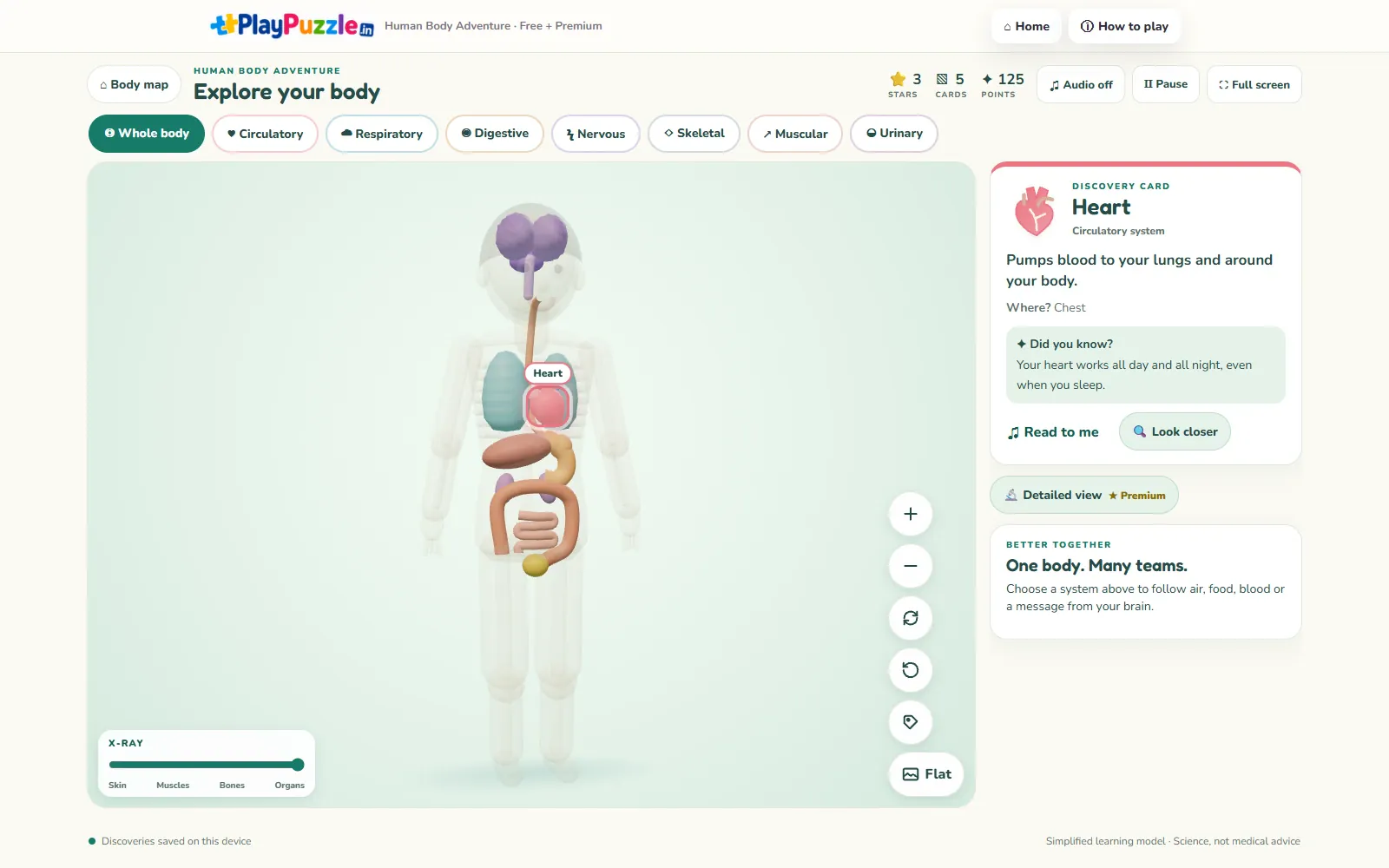
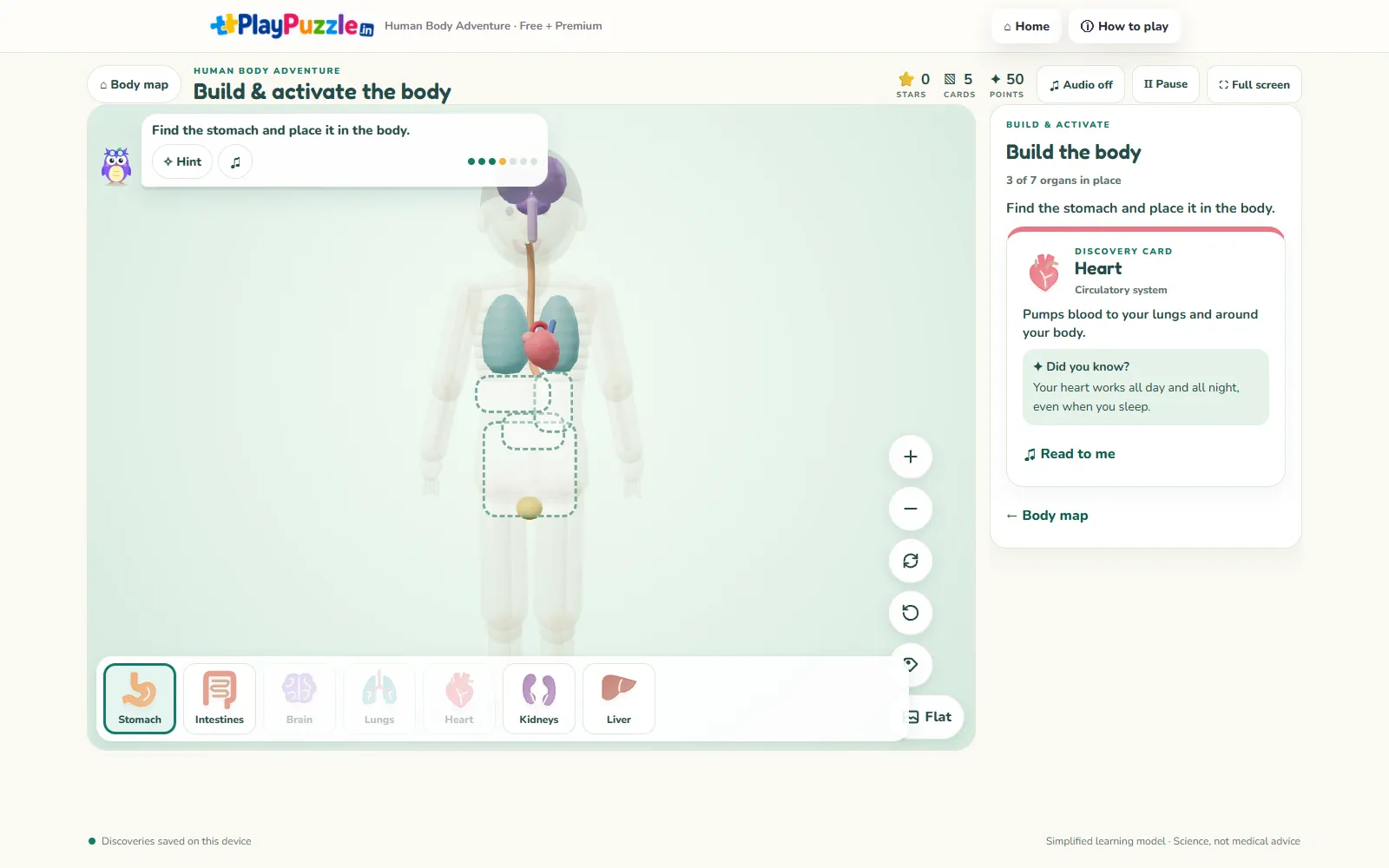
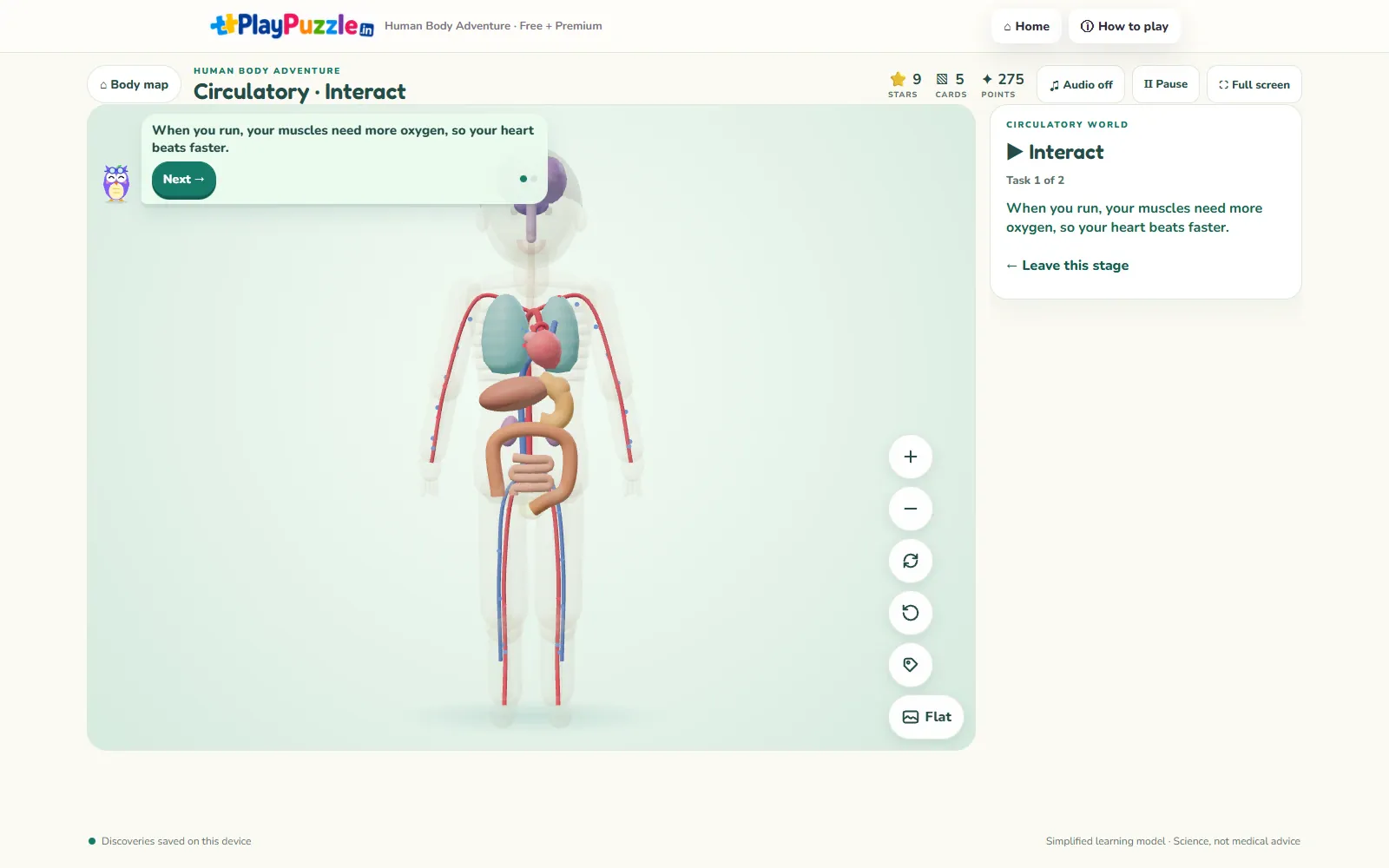
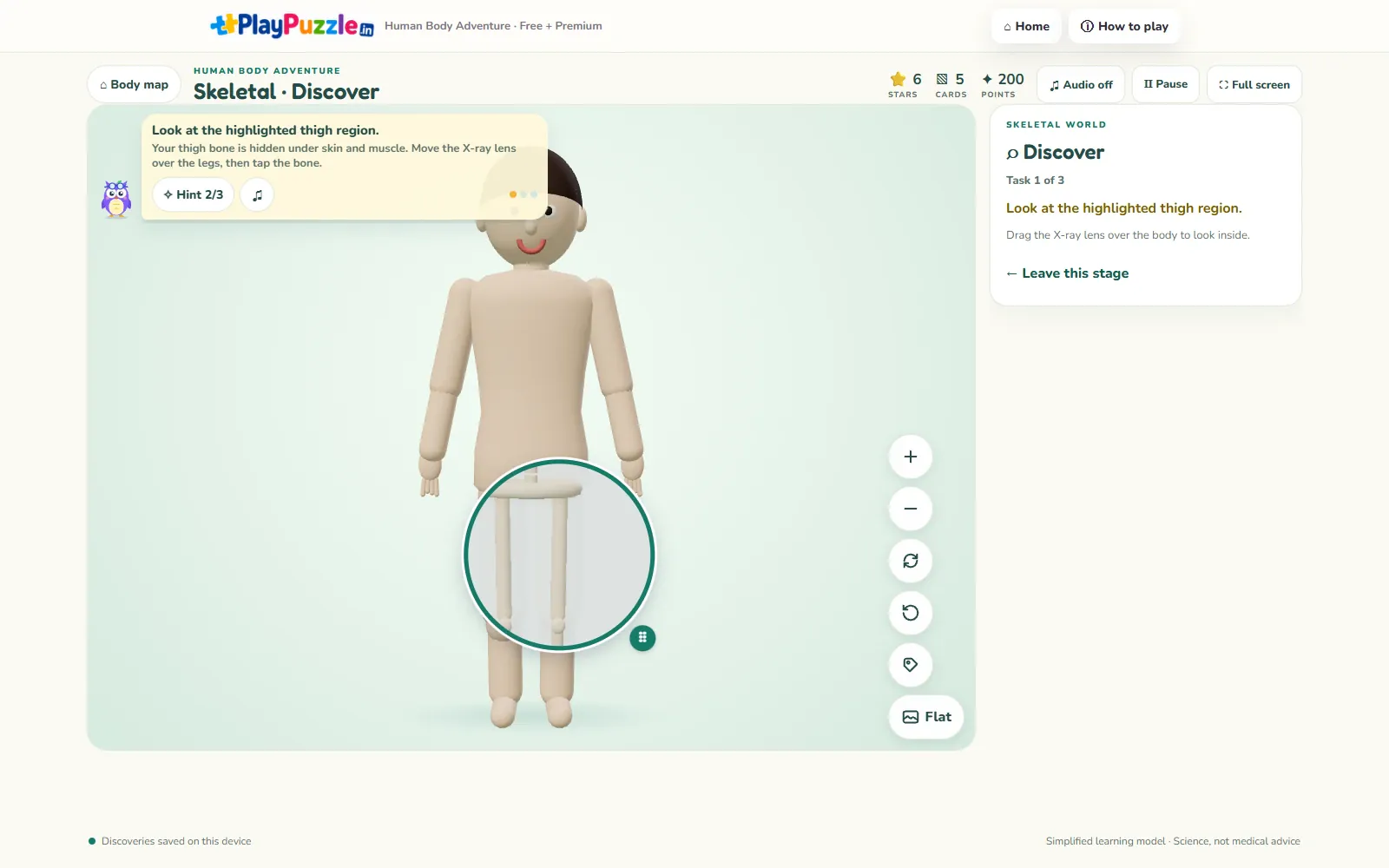
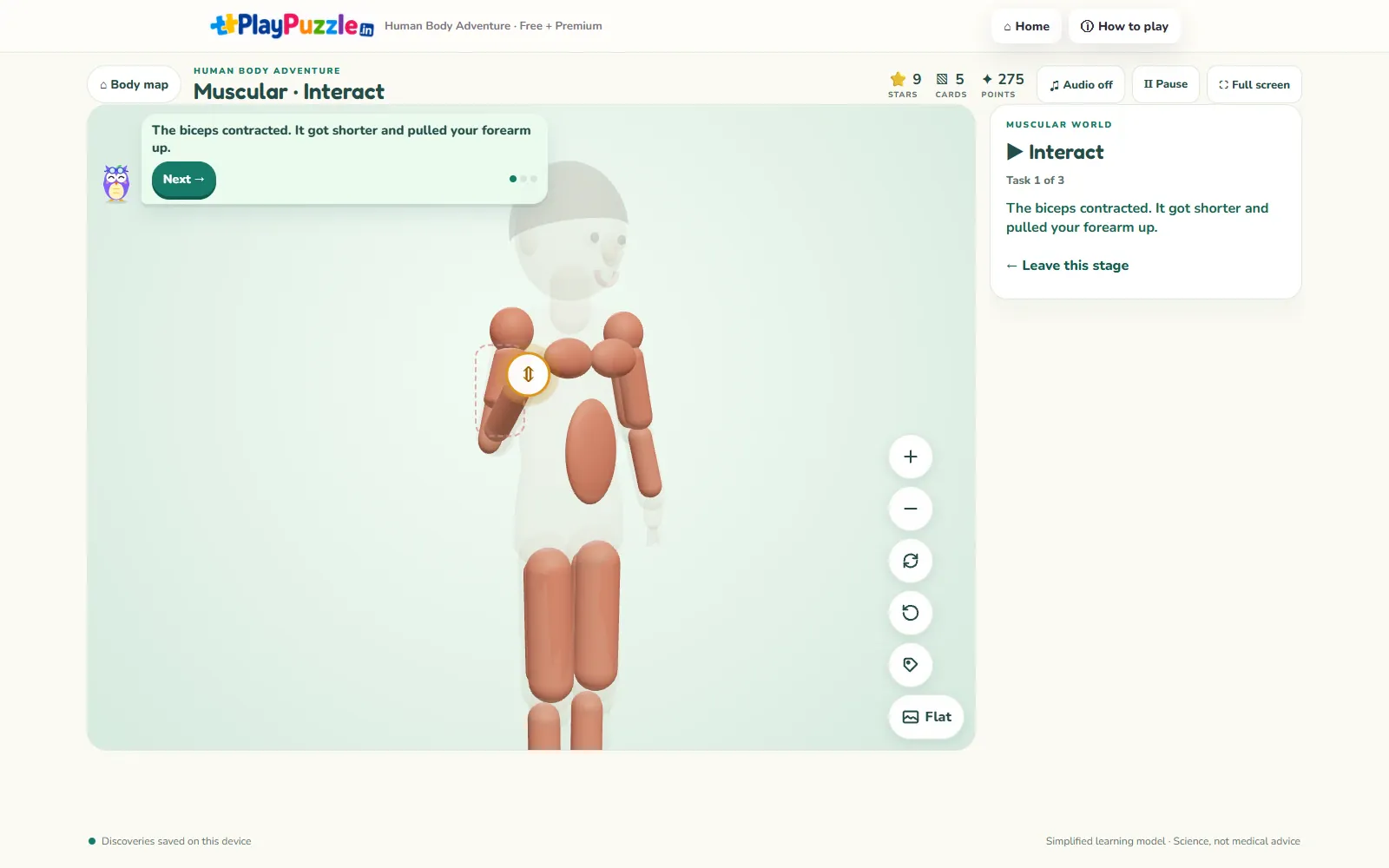
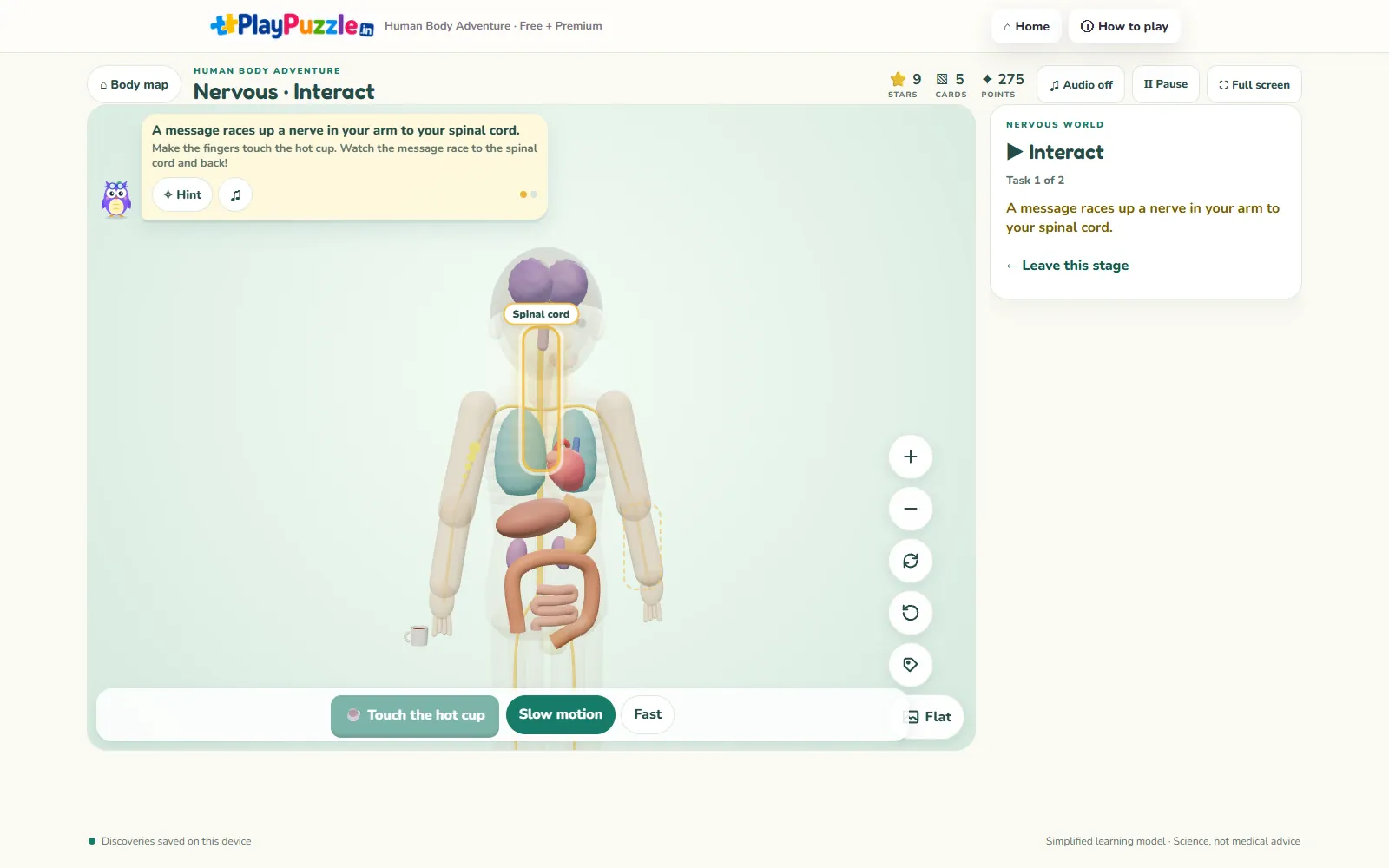
Become a body explorer! Spin a friendly 3D body all the way round, zoom in, and slide the X-ray from skin to muscles, bones and organs. Build the body by placing the brain, lungs, heart, stomach, liver, kidneys and intestines, then switch it on and watch every organ work. In the heart and lungs worlds, make the body sleep or run and see the heart speed up, follow the blood from the heart to the lungs and back, and breathe in yourself to watch the diaphragm move. Each world has six stages, from Explore to Master, and a badge to earn. Exploring, Build & Activate and the heart and lungs worlds are free. PlayPuzzle Premium adds five more worlds: the digestive world (follow a mouthful of food from mouth to large intestine), the urinary world (watch the kidneys clean the blood and the bladder fill), the skeletal world (scan for hidden bones with an X-ray lens and rebuild the skeleton), the muscular world (bend the arm and watch the biceps shorten while the triceps stretches) and the nervous world (follow a message from a hot cup to the spinal cord and back), plus a detailed view with the heart’s chambers, the parts of the brain and the named bones. This simplified anatomy game teaches science, not health or medical advice.
Skills kids can practice
Features
- Interactive 3D body: spin, zoom, X-ray layers and Look closer
- Build & Activate the body, then switch it on
- Animated heartbeat, blood flow and breathing you can control
- Circulatory and respiratory worlds with six stages each (free)
- Premium: digestive, urinary, skeletal, muscular and nervous worlds, and a detailed view
- Drag, tap-to-place and keyboard controls; flat view when 3D is unavailable
- Replayable narration and gentle sounds you can switch off
- Stars, discovery cards and system badges earned in Master
- Progress saved on this device; account sync when signed in
- Reduced-motion support and friendly untimed learning
How to Play
- Drag the body to spin it, pinch or press plus to zoom, and slide the X-ray to see muscles, bones or organs.
- Tap any part to open its discovery card, or choose Look closer to see it on its own.
- In Build & Activate, tap an organ card and then its place on the body (or drag the card there). Keyboard players can use Tab and Enter.
- Open a body system world and play its stages in order, from Explore to Master. Use hints when you need them.
- Switch the body on, make it sleep or run, and hold Breathe in to watch the diaphragm move.
- In the bones and muscles worlds, drag the hand or foot (or press Bend) to bend the elbow or knee, and move the X-ray lens to find hidden parts.
What Kids Learn
- Names and locations of familiar body parts and major organs
- How the heart, lungs and brain help the body work
- How food moves through the digestive tract
- Why kidneys belong to the urinary system, not the digestive system
- How bones, muscles and nerves work together to help movement
Age Group
Ages 6 to 12. Younger children can begin with familiar body parts. Older children can explore organ functions and the relationships between systems.
Learning Benefits
- Connects body-part names to locations and functions
- Builds vocabulary with readable text and optional narration
- Encourages curiosity through independent exploration
- Practices observation, sequencing and cause-and-effect reasoning
Explore Human Body Systems
Circulatory System
Follow blood from the heart to the lungs, back to the heart, then around the body.
Respiratory System
Follow air through the nose or mouth and windpipe to the lungs.
Digestive System
Follow food from the mouth, through the esophagus, to the stomach and intestines.
Nervous System
See how the brain, spinal cord and nerves carry messages.
Skeletal System
Discover how bones support the body and protect organs.
Muscular System
Learn how contracting muscles pull on bones to make movement.
Urinary System
Discover how kidneys filter blood to make urine.
FAQs
What age is Human Body Adventure for?
The game is designed for ages 6–12. Younger learners can begin with familiar external body parts; older learners can explore system relationships and journeys.
Is this game free?
Yes, to start. Exploring the 3D body, Build & Activate, and the heart and lungs worlds are free with no sign-in. PlayPuzzle Premium adds the digestive, urinary, skeletal, muscular and nervous worlds and the detailed view. Progress is saved in this browser when storage is available.
Can children play on a phone or tablet?
The game has responsive layouts and touch controls. Tap a piece and then its place as an alternative to dragging. Zoom and pan help with smaller parts.
Does the game show realistic medical images?
No. It uses a friendly, toy-like 3D body and simplified, non-graphic organs. Organ positions and functions are introduced for science education, not medical advice.
Can children explore without completing missions?
Yes. Explore is always available and free. Spin the body, use the X-ray, tap organs to hear their stories, and choose a system to follow a guided journey.
What if the 3D view does not work on our device?
The game switches to a flat view automatically when 3D is not available, and you can choose the flat view at any time. Every activity works in both views.
How do narration and progress work?
Text remains available whether audio is on or off. Narration uses PlayPuzzle’s shared audio system with browser speech as a fallback. Discoveries and mission stars are saved on this device; signed-in account syncing depends on platform availability.
Related Educational Games
- Ocean Explorer — Pilot a research submarine through seven ocean zones, photograph 50+ marine creatures, complete missions, and protect the sea.
- Food Chain Adventure — Explore six colorful habitats, connect organisms in energy-flow order, build food webs, and watch each ecosystem come alive.
- Physics Playground for Kids — Build with ramps, levers, pulleys, wheels and weights in a 3D science lab, then test each invention with real simulated physics.
Try It in the Science Lab
- Virtual Microscope Lab — Zoom into onion skin, pondweed, pond water and more: focus a virtual microscope, stain and prepare slides, spot cells and tiny living things, and measure them.
- Photosynthesis Lab — Grow a bean plant with light, water and air, count oxygen bubbles from pondweed, test leaves for starch and watch a leaf swap gases with the air.
- DNA Builder — Pair DNA's letters to build the second strand, twist it into a 3D double helix, unzip it to make two copies, and read a real gene's code into a protein.