About the lab
What is the pH scale?
The pH scale runs from 0 to 14. Acids are below 7, bases are above 7, and pure water sits in the middle at 7. In the lab, children test everyday substances one by one and see where each lands: lemon juice near 2, milk just under 7, baking soda solution about 8, and soapy water around 10.
Older learners see what the numbers mean. Each step on the scale is ten times more or fewer hydrogen ions, so diluting an acid tenfold raises its pH by one. The lab works this out from real chemistry, so the same mix always gives the same answer.
Indicators that change colour
Red cabbage juice is purple, turns pink in acids and blue or green in bases. Universal indicator paints a whole rainbow from red to violet. Explorers add litmus, and Advanced players use phenolphthalein, which stays clear in acid and turns pink in a base. Mystery bottles turn the colour charts into detective work.
Neutralising and fizzing
Add a base to an acid and the two cancel out. Children neutralise vinegar with baking soda solution until the indicator turns green, and find out that adding water alone never gets an acid past neutral. At the Advanced level a burette and a live titration curve show how steeply the pH jumps at the end point.
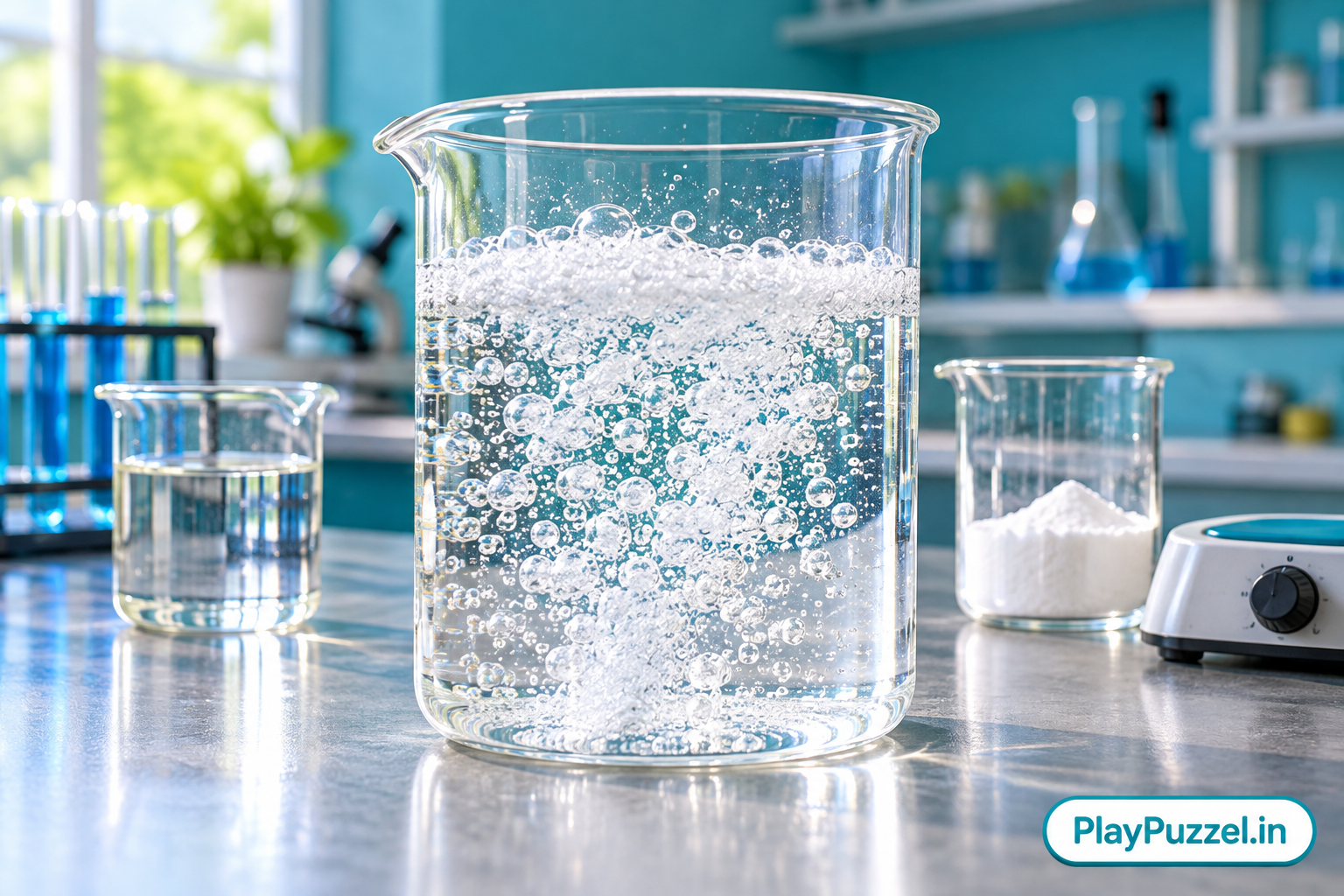
When an acid meets a carbonate such as baking soda or chalk, carbon dioxide fizzes out. The amount of gas depends on how much carbonate reacts, so a balloon fills up and a gas syringe can be read in millilitres. A hydroxide neutralises an acid with no bubbles at all, which shows the difference between the two kinds of reaction.
Chemistry in everyday life, safely
The Real life bench shows how an antacid settles stomach acid, why toothpaste protects tooth enamel, how baking soda makes a cake rise and what makes a model volcano foam. Everything happens on screen. The lab explains that real chemicals can hurt skin and eyes, that chemicals should never be tasted, and that cleaning products must never be mixed.
Experiments you can try
Beginner, ages 6–8 Free, no sign-in
- Is lemon juice an acid?
- Find a base
- Find something neutral
- Turn cabbage juice pink
- Turn it green
- Make it fizz
Explorer, ages 9–11 Free with sign-in
- Paint the pH rainbow
- Mystery bottles
- Neutralise the vinegar
- Can water make it neutral?
- Settle a sour stomach
- Fill the balloon
Advanced, ages 12–14 PlayPuzzle Premium
- Strong or weak?
- Ten times weaker
- Titrate to neutral
- The first pink
- Balance the equation
- Measure the gas
How to play
- Pick a bench: Test it, Colour detectives, Mix and neutralise, Fizz lab or Real life.
- Drag a bottle onto the glassware, or tap it, to pour.
- Add an indicator or dip the pH meter and watch what happens.
- Read the explanation that appears after every result.
- Complete missions for stars and answer a quick question after each one.
- Switch to free explore to try any mix you like.
What kids learn
- Acids have a pH below 7, bases above 7 and neutral substances 7.
- Indicators such as red cabbage juice change colour with pH.
- An acid and a base neutralise each other to make a salt and water.
- Carbonates fizz with acids and give off carbon dioxide.
- Adding water weakens an acid but never makes it neutral.
- Strong acids ionise completely and weak acids only partly.
- Each step on the pH scale is a factor of ten.
Skills practised
Levels and ages
- Beginner, ages 6–8: Free, no sign-in, 6 missions.
- Explorer, ages 9–11: Free with sign-in, 12 missions.
- Advanced, ages 12–14: PlayPuzzle Premium, 18 missions.
Levels are opened by plan and never locked by age, so any child can pick the level that suits them.
Is it safe?
Everything here is a virtual experiment. Real chemicals can hurt skin and eyes: never taste chemicals, and never mix cleaning products.
Frequently asked questions
What is the difference between an acid and a base?
Acids release hydrogen ions in water and have a pH below 7; many taste sour, like lemons. Bases have a pH above 7; ones that dissolve in water are called alkalis and release hydroxide ions. Soap and baking soda are bases.
Why does red cabbage juice change colour?
Red cabbage contains pigments called anthocyanins. Their shape changes with the pH, and each shape reflects a different colour: pink and red in acids, purple near neutral, and blue, green and yellow in bases.
Why do baking soda and vinegar fizz?
Baking soda is a carbonate. When an acid meets it, carbonic acid forms and falls apart into water and carbon dioxide gas, which makes the bubbles.
Are cleaning products safe to mix together?
No. Some cleaning products give off harmful gases when they are mixed, so they must never be combined. This lab is virtual for that reason, and it only uses everyday examples like lemon juice, vinegar and soap.
What age is the Acids & Bases Lab for?
It is designed for ages 7 to 14. Beginners classify and colour; Explorers neutralise and read indicators; Advanced learners work with strong and weak acids, titrations, gas volumes and balanced equations.
Do I need to sign in?
No. The Beginner level is free to play without an account. A free sign-in unlocks the Explorer level and saves progress, and PlayPuzzle Premium unlocks the Advanced level.