About the lab
What is the Electron Shell Lab?
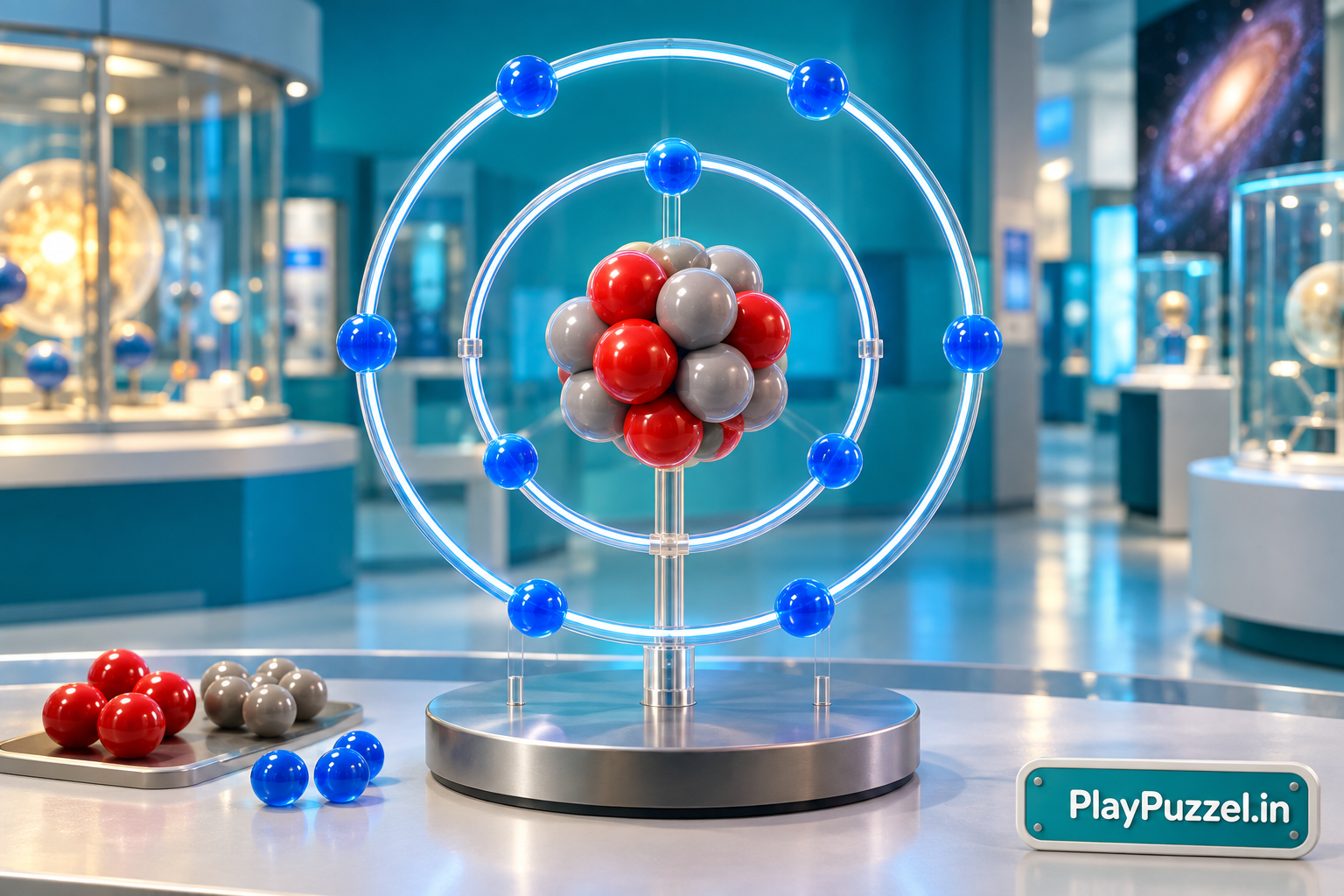
Each atom in the lab has a nucleus and a set of shells around it. As a child adds electrons, each one drops into the lowest shell with room, and the lab counts how many sit in the outer shell. A full outer shell glows, and the lab explains why that atom, like neon or argon, hardly reacts with anything.
Missions ask for a particular arrangement: fill the first shell, fill two shells, or leave just one electron on its own in the outer shell. That last one is the secret of sodium and its family, and it is why they react so strongly.
From shells to the periodic table
Atoms with the same number of outer electrons behave alike, and that is why they sit in the same column of the periodic table. By building lithium, sodium and potassium in turn, children see the pattern for themselves rather than memorising it.
Explorer adds the shell notation scientists use, such as 2,8,1. Advanced goes further, to elements with four shells such as potassium and krypton, and to the subshell notation used in secondary school chemistry.
Learning without pressure
There are no timers and nothing is marked wrong. If an arrangement is not quite right, the lab says what it can see, such as one electron too many, and a hint is always available. Free explore mode lets children fill shells just to watch the pattern grow.
Experiments you can try
Beginner, ages 6–8 Free with sign-in
- Fill the first shell
- Fill two shells
- Just one outer electron
Explorer, ages 9–11 Free with sign-in
- Three full shells
- Sodium's cousin
Advanced, ages 12–14 PlayPuzzle Premium
- Four shells
- A noble gas with four shells
How to play
- Sign in free, then choose a level and a mission.
- Add electrons one at a time and watch which shell each one fills.
- Add protons to keep the atom neutral, or leave it charged on purpose.
- Check the outer shell counter and the lab's notes on the atom.
- Complete the mission for stars, or switch to free explore.
What kids learn
- That electrons are arranged in shells around the nucleus
- That shells fill from the inside out
- Why atoms with a full outer shell, the noble gases, hardly react
- Why atoms with one outer electron react strongly
- How outer electrons explain the columns of the periodic table
- How to write shell arrangements such as 2,8,1
Skills practised
Levels and ages
- Beginner, ages 6–8: Free with sign-in, 3 missions.
- Explorer, ages 9–11: Free with sign-in, 5 missions.
- Advanced, ages 12–14: PlayPuzzle Premium, 7 missions.
Levels are opened by plan and never locked by age, so any child can pick the level that suits them.
Is it safe?
Everything in the Science Lab happens on screen. Children combine curated, virtual materials only, and the lab never gives instructions for trying an experiment for real.
Frequently asked questions
What age is the Electron Shell Lab for?
It suits ages 6 to 14. Beginner uses simple words and small atoms, Explorer adds shell notation, and Advanced reaches four shells and subshell notation.
Is the Electron Shell Lab free?
It is free with a PlayPuzzle account. Sign in to open it at the Beginner and Explorer levels and to save progress; PlayPuzzle Premium adds the Advanced level and more elements.
How is it different from Build an Atom?
Build an Atom is about what an atom is made of: protons, neutrons and electrons. The Electron Shell Lab focuses on how the electrons are arranged, which explains how atoms react and how the periodic table is organised.
Are the shell arrangements real?
Yes. The lab uses the real arrangements of electrons for each element. Drawing electrons in circular shells is a simplified model, the same one used when shells are first taught in school.