About the lab
What is the Rock Cycle Lab?
Rocks seem permanent, but over millions of years every rock is broken down, buried, baked or melted and made into something new. On the Rock cycle bench, children choose a starting rock and apply real processes: weathering turns granite into sand, burial squashes the sand into sandstone, heat and pressure change it into quartzite, and melting and cooling make igneous rock again. Each step is drawn on the cycle diagram, so the journey shows how the three families of rock are connected.
The Cooling bench explains why igneous rocks look so different. The same magma cooled slowly underground grows big crystals, as in granite; cooled quickly as a lava flow it makes fine-grained basalt; poured into the sea it sets as glass; and frothing with gas it becomes pumice, a rock that floats.
Three levels, from rock families to geological evidence
Beginners learn the three families and the main processes, make granite and basalt, build layers and find the oldest, and try the fizz and float tests. Explorers make slate, volcanic glass and pumice, find fossils in their layers and identify six mystery rocks from their clues. Advanced learners follow metamorphic grade from shale to gneiss, compare gabbro with basalt, and use cross-cutting relationships to show that magma cutting through the layers is younger than all of them.
Geology you can test, safely
Real rock testing uses acid, and magma is far hotter than any oven. In the lab every test is instant and safe, so children can repeat it on every rock, compare the results in a table and build the reasoning a geologist uses: texture tells you how a rock formed, and simple tests confirm it. Each result comes with a short explanation written for the child's level.
How it fits with other PlayPuzzle science
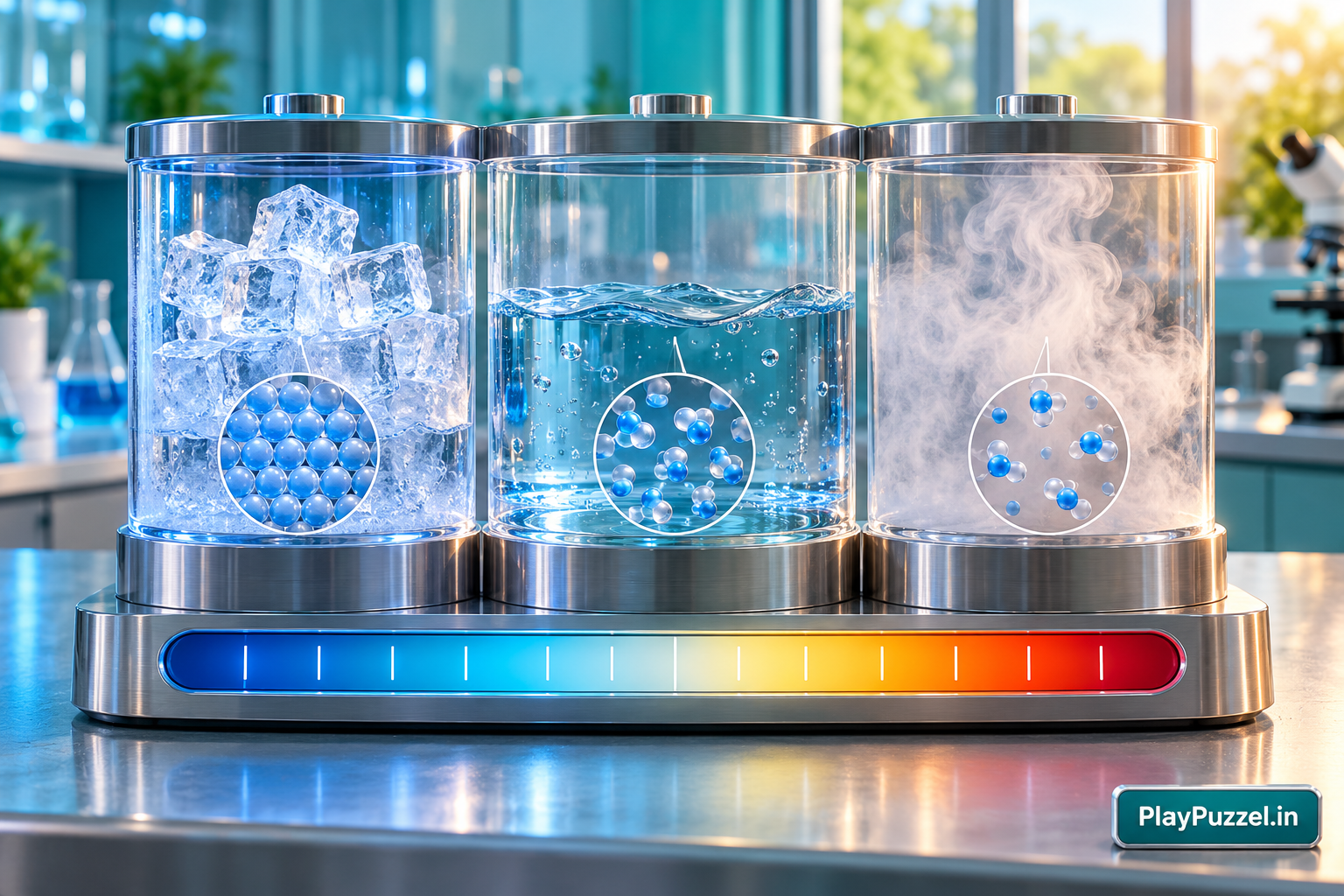
States of Matter explains melting and freezing with particles, which is what happens to rock as it melts into magma and crystallises again. What Happens If? and the Experiment Playground let children mix limestone with vinegar or press sand into sandstone as experiments of their own, and Solar System Explorer looks at the rocky planets beyond our own.
Experiments you can try
Beginner, ages 6–8 Free, no sign-in
- From granite to sandstone
- Make marble
- Melt it, cool it
- All the way round
- Big crystals
- Dark lava
- Three layers
- The oldest layer
- The fizz test
- Will it float?
- Rock detective
- Fill the basin
Explorer, ages 9–11 Free with sign-in
- A slate roof
- Volcanic glass
- A rock full of holes
- Fossil hunt
- Master detective
- Fill the table
- Sandstone to quartzite
- Frothy lava
- Does marble fizz too?
- Squeeze granite
Advanced, ages 12–14 PlayPuzzle Premium
- Deeper and hotter
- Same magma, different rock
- Which came last?
- The long way round
How to play
- Choose a bench: Rock cycle, Cooling, Layers or Rock detective.
- On the Rock cycle, pick a starting rock and press a process such as Weathering or Heat and pressure.
- On Cooling, choose pale or dark magma and where it cools, then watch the crystals grow.
- On Layers, drop sand, mud and shells into the sea, bury them, then tap the oldest layer.
- On Rock detective, test a mystery rock, then sort it into igneous, sedimentary or metamorphic.
- Play missions for stars, or explore freely and collect discoveries.
What kids learn
- Rocks belong to three families: igneous, sedimentary and metamorphic.
- Weathering, burial, heat and pressure, melting and cooling change one rock into another.
- Slow cooling grows big crystals; fast cooling makes small crystals or glass.
- Sediment settles in layers, with the oldest at the bottom, and shells can become fossils.
- Limestone and marble fizz in acid because they are calcium carbonate.
- How to use evidence from tests to classify a rock.
Skills practised
Levels and ages
- Beginner, ages 6–8: Free, no sign-in, 12 missions.
- Explorer, ages 9–11: Free with sign-in, 22 missions.
- Advanced, ages 12–14: PlayPuzzle Premium, 26 missions.
Levels are opened by plan and never locked by age, so any child can pick the level that suits them.
Is it safe?
Everything in this lab happens on screen. Magma and lava are dangerously hot, and real rock tests use acid, so geologists wear protection and we explore them here.
Frequently asked questions
What is the rock cycle, in simple words?
It is the way rocks slowly change from one kind into another. Rocks break into sediment, sediment is squashed into new rock, heat and pressure change rock, and rock can melt into magma that cools into new rock again.
What are the three types of rock?
Igneous rock forms when melted rock cools, sedimentary rock forms from layers of sediment, and metamorphic rock forms when heat and pressure change a rock without melting it.
Why does granite have bigger crystals than basalt?
Granite cools slowly deep underground, so its crystals have thousands of years to grow. Basalt cools quickly as lava at the surface, so its crystals stay tiny.
Why does limestone fizz in acid?
Limestone is made of calcium carbonate from shells. Acids react with calcium carbonate and give off carbon dioxide gas, which makes the bubbles.
Can a rock really float?
Yes. Pumice forms from frothy lava full of gas, so it is full of tiny bubbles and is lighter than the same amount of water.
Is the Rock Cycle Lab free?
Yes. The Beginner level is free with no sign-in. A free account opens the Explorer level and two more mystery rocks, and PlayPuzzle Premium opens Advanced.