About the lab
What is the Volcano Lab?
Every eruption is a contest between gas and magma. Magma carries dissolved gas, and as it rises the gas comes out as bubbles, like opening a fizzy drink. In runny magma the bubbles slip out and lava pours or fountains from the vent. In sticky magma they are trapped, pressure builds, and the magma is blasted into ash and pumice. On the Erupt bench children change one setting at a time and watch the eruption change with it, from a gentle Hawaiian flow to a Plinian column.
A cut-away view shows the inside of the volcano: the magma chamber, the pipe up to the crater and the gas bubbles growing as magma rises. On the Inside bench children see bubbles escape from runny magma and get stuck in sticky magma, and watch the pressure gauge climb.
Three levels, from gentle or explosive to Plinian columns
Beginners set the runniness, the gas and the vent width, make flows, fountains, domes and explosions, and learn that sticky, gassy magma explodes. Explorers add temperature and fissure vents, run fair tests by changing one thing at a time, and build shield volcanoes, cinder cones and stratovolcanoes from many eruptions. Advanced learners choose the magma's silica content, see how it sets viscosity together with temperature, and explain why the biggest eruption columns collapse into pyroclastic flows.
Predict, test, explain
Before each eruption children can predict what kind it will be, then compare their prediction with the result. After every eruption the lab shows why it happened in a short chain, such as sticky magma and lots of gas, so the gas is trapped, pressure builds and the eruption is explosive. Earlier runs stay on screen to compare, which turns play into real scientific reasoning.
How it fits with other PlayPuzzle science
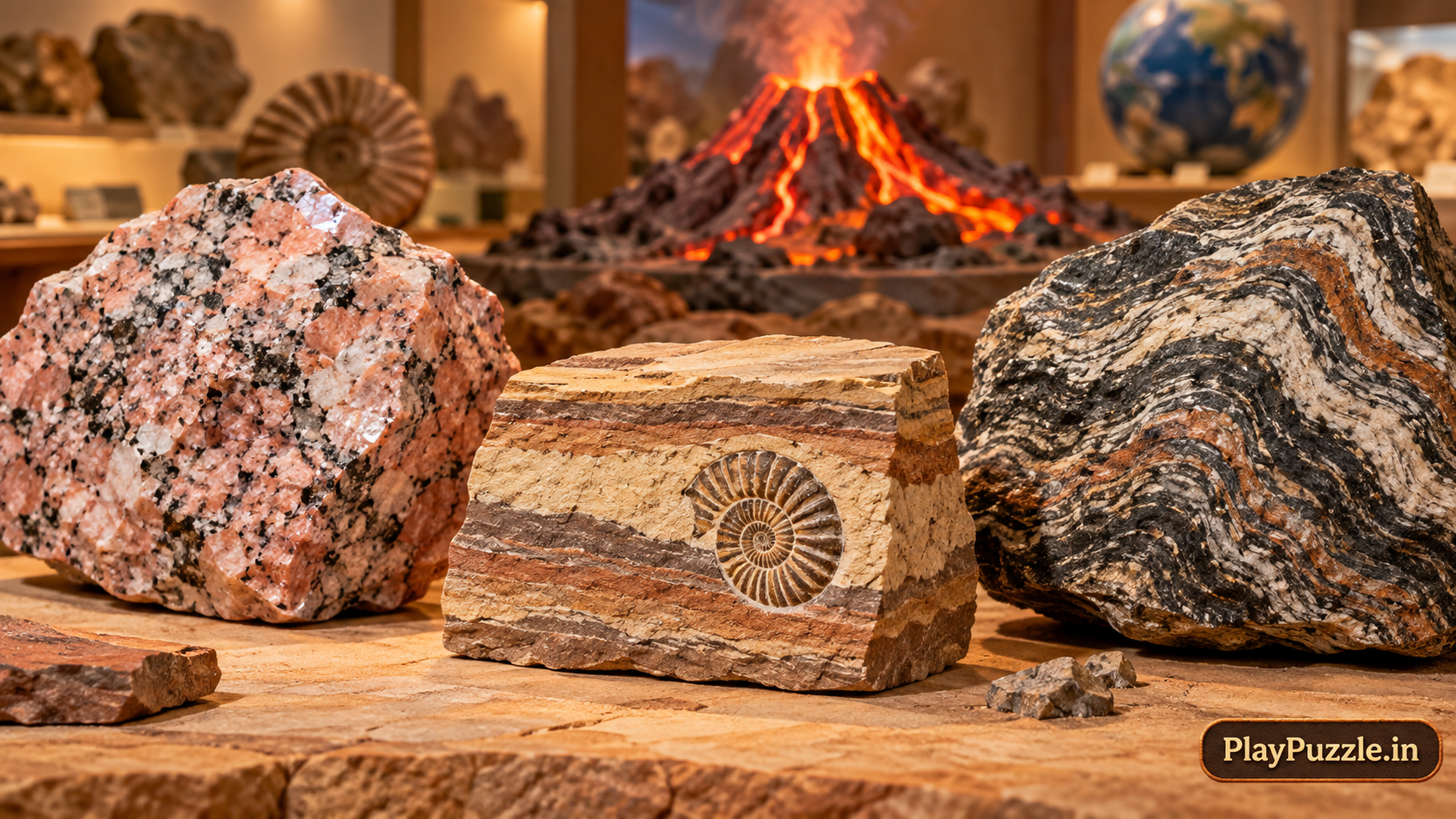
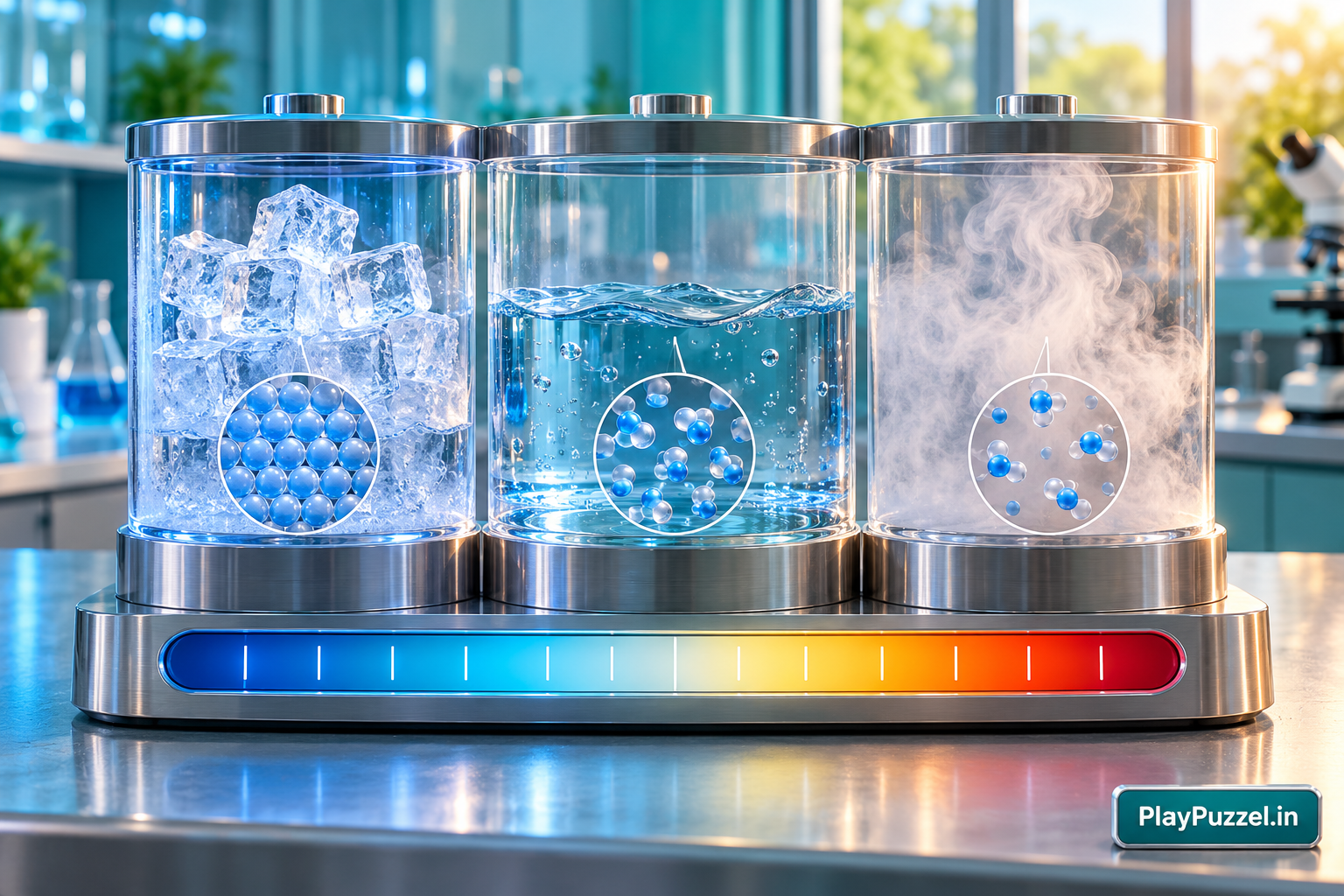
Volcanic rocks are where the Rock Cycle Lab begins: the What it leaves bench traces basalt, scoria, pumice, obsidian and rhyolite back to the eruptions that made them, and the Rock Cycle Lab follows them as they weather, bury and melt. States of Matter explains melting and gas bubbles with particles.
Experiments you can try
Beginner, ages 6–8 Free, no sign-in
- A gentle lava flow
- Fountain of fire
- Make it explode
- Grow a dome
- Predict, then erupt
- Three kinds of eruption
- Trap the gas
- Let the gas escape
- Where did pumice come from?
Explorer, ages 9–11 Free with sign-in
- Curtain of fire
- Lava bombs
- The cork pops
- Only the vent
- Turn up the heat
- Build a shield
- Build a cinder cone
- Build a stratovolcano
- Rock clues
Advanced, ages 12–14 PlayPuzzle Premium
- Only the silica
- Column collapse
- Every eruption style
How to play
- Choose a bench: Erupt, Inside, Build a volcano or What it leaves.
- On Erupt, set how runny the magma is, how much gas it has and how wide the vent is.
- Pick a prediction, then press Erupt and watch what happens.
- Read why it happened, then change one thing and erupt again to compare.
- On What it leaves, pick a volcanic rock and choose the eruption that made it.
- Play missions for stars, or explore freely and collect discoveries.
What kids learn
- Magma contains dissolved gas that forms bubbles as it rises.
- Runny magma lets gas escape, so it erupts gently as lava flows and fountains.
- Sticky magma traps gas, so pressure builds and the eruption is explosive.
- Hotter magma is runnier, and magma with more silica is stickier.
- Different eruptions build different volcanoes: shields, cinder cones and stratovolcanoes.
- Volcanic rocks record how they erupted: holes, glass and crystal size are clues.
- How to run a fair test by changing one thing at a time.
Skills practised
Levels and ages
- Beginner, ages 6–8: Free, no sign-in, 9 missions.
- Explorer, ages 9–11: Free with sign-in, 18 missions.
- Advanced, ages 12–14: PlayPuzzle Premium, 21 missions.
Levels are opened by plan and never locked by age, so any child can pick the level that suits them.
Is it safe?
Everything here happens on screen. Real lava is dangerously hot and eruptions throw out rock and ash, so volcano scientists watch from a safe distance.
Frequently asked questions
Why do some volcanoes explode while others just pour out lava?
It depends on the magma. Runny magma lets gas bubbles escape easily, so lava flows out gently. Sticky magma traps the gas, pressure builds up, and the magma is blasted apart in an explosion.
What is viscosity?
Viscosity is how thick or runny a liquid is. Honey has a high viscosity and water a low one. Magma with lots of silica, or that is cooler, has a high viscosity.
What is the difference between magma and lava?
Magma is melted rock underground. Once it comes out of a volcano onto the surface, it is called lava.
What are the main types of volcano?
Shield volcanoes are wide with gentle slopes, built from runny lava. Cinder cones are small and steep, built from cinders. Stratovolcanoes are tall and steep, built from layers of ash and lava.
What is a pyroclastic flow?
It is a fast cloud of hot ash, rock and gas that races down a volcano. It can happen when an eruption column becomes too heavy to stay up and collapses.
Is the Volcano Lab free?
Yes. The Beginner level is free with no sign-in. A free account opens the Explorer level, and PlayPuzzle Premium opens Advanced.